
Code, Explained

Secure GitHub Actions Deployment to Ubuntu Using a Dedicated Deploy User

Automating deployment from GitHub to an Ubuntu server doesn’t need to mean giving GitHub access to root.

A better approach is to create a dedicated deploy user, allow GitHub Actions to SSH into the server as that user, and then give deploy permission to execute only one specific deployment script as another user.

This post walks through that setup.


Architecture

The deployment flow will look like this:

Developer
    │
    │ git push
    ▼
GitHub Repository
    │
    │ GitHub Actions
    ▼
GitHub Actions Runner
    │
    │ SSH
    ▼
deploy user
    │
    │ sudo -u dockeruser
    │ NOPASSWD
    ▼
dockeruser
    │
    │ execute deployment script
    ▼
/var/www/example.com
    │
    │ git pull
    ▼
Latest Code

The important security principle is:

GitHub should not need root access to the production server.


1. Add GitHub Actions

GitHub Actions workflows are stored inside:

.github/workflows/

Create a workflow file in your repository:

.github/workflows/deploy.yml

For example:

name: Deploy

on:
  push:
    branches:
      - main

jobs:
  deploy:
    runs-on: ubuntu-latest

    steps:
      - name: Deploy to server
        uses: appleboy/ssh-action@YOUR_PINNED_COMMIT_SHA
        with:
          host: ${{ secrets.SERVER_HOST }}
          username: deploy
          key: ${{ secrets.SERVER_SSH_KEY }}
          script: |
            sudo -u dockeruser /usr/local/bin/git-pull-by-dockeruser

Every time code is pushed to the main branch, GitHub Actions connects to the server and executes:

sudo -u dockeruser /usr/local/bin/git-pull-by-dockeruser

GitHub Secrets

Go to:

Repository
→ Settings
→ Secrets and variables
→ Actions

Create these secrets:

SERVER_HOST
SERVER_SSH_KEY
SERVER_FINGERPRINT

SERVER_HOST

Your server hostname or IP address.

SERVER_SSH_KEY

Store the complete private SSH key, including:

-----BEGIN OPENSSH PRIVATE KEY-----
...
-----END OPENSSH PRIVATE KEY-----

Do not remove the line breaks.

The corresponding public key will be installed on the server for the deploy user.

SERVER_FINGERPRINT

This is the SSH server’s host-key fingerprint.

On Ubuntu, you can obtain it with:

ssh-keygen -lf /etc/ssh/ssh_host_ed25519_key.pub -E sha256

It will look similar to:

256 SHA256:xxxxxxxxxxxxxxxxxxxxxxxxxxxxxxxxxxxxxxxxxxx server (ED25519)

Store the SHA256:... portion in:

SERVER_FINGERPRINT

Using the fingerprint prevents the deployment process from blindly trusting an unknown SSH server.


2. Create a Dedicated Deploy User on Ubuntu

Instead of allowing GitHub Actions to connect as root, create a dedicated user:

sudo adduser deploy

If you don’t need an interactive shell, you can still use /bin/bash for troubleshooting and later restrict access further.

Create the SSH directory:

sudo mkdir -p /home/deploy/.ssh
sudo chmod 700 /home/deploy/.ssh

Add the public key:

sudo nano /home/deploy/.ssh/authorized_keys

Paste the public key corresponding to the private key stored in:

SERVER_SSH_KEY

Then set ownership and permissions:

sudo chown -R deploy:deploy /home/deploy/.ssh
sudo chmod 600 /home/deploy/.ssh/authorized_keys

Test the connection:

ssh deploy@your-server

If everything is configured correctly, GitHub Actions can authenticate as:

deploy

without using a root account.


3. Create the Deployment Script

Now create a script that performs the actual Git operation.

Create:

sudo nano /usr/local/bin/git-pull-by-dockeruser

Example:

#!/bin/bash

set -e

PROJECT="/var/www/example.com"

cd "$PROJECT"

echo "Running Git pull as: $(whoami)"

git pull origin main

echo "Deployment completed."

Make the script executable:

sudo chmod 755 /usr/local/bin/git-pull-by-dockeruser

Most importantly, make it owned by root:

sudo chown root:root /usr/local/bin/git-pull-by-dockeruser

This prevents the deploy user from modifying the script.


4. Allow Deploy to Run Only This Script as dockeruser

The Git operation needs to run as:

dockeruser

rather than:

deploy

We can use sudo for this.

Create a dedicated sudoers configuration:

sudo visudo -f /etc/sudoers.d/deploy-git

Add:

deploy ALL=(dockeruser) NOPASSWD: /usr/local/bin/git-pull-by-dockeruser

This means:

The deploy user may execute /usr/local/bin/git-pull-by-dockeruser as dockeruser without entering a password.

It does not give deploy unrestricted sudo access.

For example, this is intentionally avoided:

deploy ALL=(ALL) NOPASSWD: ALL

That would give the deployment account far more privileges than necessary.


5. Test the Sudo Permission

Switch to the deployment user:

sudo -iu deploy

Then execute:

sudo -u dockeruser /usr/local/bin/git-pull-by-dockeruser

It should run without asking for a password.

You can also check the allowed sudo commands:

sudo -l

You should see something similar to:

(dockeruser) NOPASSWD: /usr/local/bin/git-pull-by-dockeruser

6. Make Sure dockeruser Can Write to the Git Repository

Because the Git command runs as dockeruser, the repository must be writable by that user.

For example:

sudo chown -R dockeruser:www-data /var/www/example.com

The important part is that dockeruser must be able to write to:

/var/www/example.com/.git/

especially:

.git/objects
.git/refs

Otherwise git pull can fail with an error such as:

error: insufficient permission for adding an object to repository database .git/objects
fatal: failed to write object
fatal: unpack-objects failed

Test directly:

sudo -u dockeruser git -C /var/www/example.com pull origin main

If that works, the GitHub Actions deployment should also work.


7. GitHub Actions Deployment

Once everything is configured, the GitHub Actions workflow only needs to execute:

script: |
  sudo -u dockeruser /usr/local/bin/git-pull-by-dockeruser

The complete flow is:

git push
   │
   ▼
GitHub
   │
   ▼
GitHub Actions
   │
   │ SSH using SERVER_SSH_KEY
   ▼
deploy
   │
   │ sudo -u dockeruser
   │ NOPASSWD
   ▼
dockeruser
   │
   ▼
git-pull-by-dockeruser
   │
   ▼
git pull origin main

8. Why Use Two Different Users?

Using separate users provides a useful security boundary.

deploy

The deploy user exists primarily for:

GitHub Actions → Server

It doesn’t need to be the owner of the application or have unrestricted server privileges.

dockeruser

The dockeruser account is responsible for:

Git repository operations

and can own the application files if that fits the server architecture.

root

Root owns the deployment script and controls the sudo permission.

This gives you:

GitHub
  ↓
deploy
  ↓
specific sudo command
  ↓
dockeruser

instead of:

GitHub
  ↓
root

The second architecture should generally be avoided.


9. Additional Security Recommendations

Don’t use root for GitHub SSH

Avoid:

username: root

Use:

username: deploy

instead.


Don’t give deploy unrestricted sudo

Avoid:

deploy ALL=(ALL) NOPASSWD: ALL

Use:

deploy ALL=(dockeruser) NOPASSWD: /usr/local/bin/git-pull-by-dockeruser

Protect the deployment script

The deployment script should be:

root:root
755

For example:

sudo chown root:root /usr/local/bin/git-pull-by-dockeruser
sudo chmod 755 /usr/local/bin/git-pull-by-dockeruser

The deploy user should not be able to modify it.


Don’t disable SSH host verification

Avoid configurations that effectively disable host verification, such as:

StrictHostKeyChecking=no

Use the server fingerprint instead:

fingerprint: ${{ secrets.SERVER_FINGERPRINT }}

Pin third-party GitHub Actions

If using:

uses: appleboy/ssh-action

don’t blindly use a moving branch such as:

uses: appleboy/ssh-action@master

For production, pin the Action to a specific commit SHA. This reduces the risk of a future change to the Action unexpectedly changing what runs in your deployment pipeline.


10. Final Recommended Setup

For a simple Ubuntu production server, this is a good structure:

GitHub Repository
       │
       │ push to main
       ▼
GitHub Actions
       │
       │ SSH
       ▼
    deploy
       │
       │ sudo
       │ NOPASSWD
       ▼
  dockeruser
       │
       ▼
git-pull-by-dockeruser
       │
       ▼
/var/www/example.com

The key principle is least privilege:

  • GitHub gets an SSH key only for deploy.
  • deploy does not get root access.
  • deploy can sudo only to dockeruser.
  • deploy can run only one specific script through sudo.
  • The deployment script is owned by root.
  • dockeruser owns/writes the Git repository.
  • SSH host verification uses a known server fingerprint.

This provides a relatively simple deployment system while keeping the privileges of the GitHub Actions credential tightly constrained.
Posted in git, linux, ubuntuTagged , , , , , ,

Create Docker Container for Hello World with Django and uWsgi Server

I was searching a Hello World implementation for Django of Python in Docker container, but can’t find any good resource at online. So, I plan to code it myself and document it.

This is pure Docker implementation, you don’t need to create any project for Django. You just need Dockerfile to see “Hello World” at browser which powered by Django and uWsgi module.

Here is high level explanation that I’m going TODO –

  • Python, Pip and setuptools installation and upgrade
  • Create requirement.txt file
  • Execute requirement.txt file with Pip
  • Create Django project
  • Modify project settings to allow our domain in Django
  • Replace project’s urls.py to send “Hello World” string to output
  • Code to run server through uWsgi module

Entire steps I’ll do into a single Dockerfile, which we need to build and run through Docker. Here is step by step implementation of Dockerfile.

FROM python:3.11.3
WORKDIR /code
RUN pip install --upgrade pip
RUN pip install setuptools
RUN pip install -U setuptools

Its pretty straight forward, we are using Python 3.11.3 and install Pip and setuptools here.

RUN echo "Django==4.2" >> requirements.txt
RUN echo "uWSGI==2.0.25" >> requirements.txt
RUN pip install -r requirements.txt

Here we create requirement.txt file where we instruct to install Django version 4.2 and uWSGI module version 2.0.25 and then we execute the newly created requirements.txt through Pip.

RUN django-admin startproject helloworlddjango
WORKDIR /code/helloworlddjango
RUN echo "ALLOWED_HOSTS = ['127.0.0.1', 'localhost', 'helpabodessltest.shahadathossain.com']" >> helloworlddjango/settings.py

In this stage we created helloworld project with django-admin (we already Django installed) also we append our project’s settings.py to allow our domain. For this we just append “ALLOWED_HOSTS” variable value.

RUN echo "from django.urls import path" > helloworlddjango/urls.py
RUN echo "from django.shortcuts import HttpResponse" >> helloworlddjango/urls.py
RUN echo "def home_page_view_hello_world(request):" >> helloworlddjango/urls.py
RUN echo "    return HttpResponse('Hello World')" >> helloworlddjango/urls.py
RUN echo "urlpatterns = [path('', home_page_view_hello_world, name='helloworld'),]" >> helloworlddjango/urls.py

This part actually pure Python code we (re)writing our urls.py file where we actually put “Hello World” string when user visit home page of our project.

RUN adduser --disabled-password --no-create-home django
USER django
ENTRYPOINT ["uwsgi", "--http", ":9000", "--workers", "4", "--master", "--enable-threads", "--module", "helloworlddjango.wsgi"]

This is another part where we run our project through uwsgi module. We can run straightly by Django’s builtin server by “manage.py” but here I covered to run uwsgi server.

Here is link https://github.com/razonklnbd/django-hello-world-with-docker where you found complete Dockerfile

To build docker container you have to have docker in your system. After ensuring docker into system you can use following commands to build and run –

sudo docker build -t django-hello-world-mshk .
sudo docker run --name djangohelloworldmshk -d --network=host django-hello-world-mshk:latest

You need to execute into the location where you put your Dockerfile. Please feel free to change container tag and name. You may like following command of docker to see the log and to delete running container (in case you are debugging something)

sudo docker logs djangohelloworldmshk
sudo docker rm $(sudo docker stop $(sudo docker ps -a -q --filter ancestor=django-hello-world-mshk --format="{{.ID}}"))
sudo docker rmi django-hello-world-mshk

That’s all for today! Thanks.

Posted in linux, Python, webdevelopmentTagged , , , ,

Install secured Proftpd w/o database w/ virtual jailed user

Recently I need to install simple ftp server to provide access. I used Proftpd which is I believe is good (I used in small project). When I starting install, I faced some technical problem and overcome it. So, I think I should write my experience for my personal future reference.

  1. Install proftpd-basic (follow https://mtxserv.com/vps-server/doc/how-to-install-a-ftp-server-with-proftpd-debian-ubuntu or any other good document available by searching internet)
    1.a) Configure to use virtual user
    1.b) Add virtual user using “ftpasswd” command
  2. Configure jail option of proftpd configuration (read – https://portal.hostingcontroller.com/kb/a222/how-to-jail-ftp-users-using-proftpd-server.aspx)
    Remove # (uncomment) in front of below line
    DefaultRoot ~
  3. Configure passive ports
    3.a) At firewall allow 20, 21 and those passive ports (example below)
    ufw allow 49xxx:49999/tcp
    ufw reload
  4. Restart proftpd

-> Test ftp connection

Secure ftp connection with self-signed TLS:

  1. Follow TLS configuration part only from https://www.makeuseof.com/install-proftpd-on-ubuntu/ or any other good document available to configure TLS
  2. Replace “TLSProtocol” settings (follow https://serverfault.com/a/1023382)
    TLSProtocol TLSv1 TLSv1.1 TLSv1.2
  3. Restart proftpd

Now test using FTP client, you may see that host name different than server. As because we used self-signed this type of warning we can ignore.

Posted in linux, ubuntuTagged , , , ,

Install php 7.2 ssh2 in ubuntu 16x

recently i need to install ssh2 connection through my php code to connect remote server by sftp for file transfer. i’m using php 7.2 and face a “sigment fault” issue for normal installation. i solved this issue by install required demon. hope it may help someone who face same issue.

first you need to install/upgrade some basic program

apt-get install gcc make autoconf libc-dev pkg-config

then install base library

apt-get install libssh2-1-dev

now install required php modules

apt-get install php7.2-dev php-pear

now install ssh by pecl (the most important part of installation)

— pecl channel-update pecl.php.net
pear config-show
— pear config-set php_ini /etc/php/7.2/apache2/php.ini
— pear config-set temp_dir /etc/php/temp/pear
pecl install ssh2-1.1.2

ignore commented line OR use if you understand by yourself

now you need to enable ssh2 extension into your php cli installation

echo “extension=ssh2.so” > /etc/php/7.2/mods-available/ssh2.ini
ln -s /etc/php/7.2/mods-available/ssh2.ini /etc/php/7.2/cli/conf.d/30-ssh2.ini

please check you php installation/configuration path. set priority on your own. i set here 30 without proper understanding 😀

now another important part is your PHP code. when we use ssh2 in fopen wraper, in other version of ssh2 connection we need to open a connection and we can use resource id. but with the above change you must use user, password, port i.e. full access information every time we need to connect to server. here is my sample code –

$fh = @fopen(‘ssh2.sftp://’ . $this->user.’:’.$this->pass.’@’.$this->ip.’:’.(intval($this->port)>0?intval($this->port):22) . $pRemoteLocation, $pMode);

all other code like directory creation or any other command execution may be same as before.

Posted in php, ubuntuTagged , , , , , , ,

Install Zend Framework 2 into Windows IIS

This article will show you how you can install Zend Framework 2 into your windows OS without composer.phar help.

1. Download latest stable copy of ZF2 from http://framework.zend.com/downloads/latest and unpack, we call it ZF2

2. Download latest stable copy of ZF2 skeleton app from https://github.com/zendframework/ZendSkeletonApplication/ and unpack, we call it ZF2Skeleton

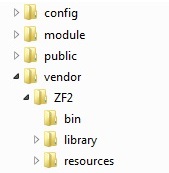
3. Create folder like <ZF2Skeleton folder>/vendor/ZF2. Now copy ZF2/* into <ZF2Skeleton folder>/vendor/ZF2 And the final directory structure may look like following image (for ZF2 version 2.3.1 dated 20140426)

zf2 basic folder structure

4. Now point any domain into “public” folder. e.g. zf2.localhost.tld

  • 4.a. Open notepad as administrator user
  • 4.b. Add an entry to your hosts (file) like – “127.0.0.1 zf2.localhost.tld” [one host in each line]
    • 4.b.1 hosts file is typically located at C:\WINDOWS\system32\drivers\etc\hosts
  • 4.c Now save the hosts file and close
  • 4.d. Now create an entry in your IIS (6 or 7 both are same procedure) by following http://support.microsoft.com/kb/816576 with the above host name i.e. zf2.localhost.tld

5. Now you need to fix ZF2_PATH or $zf2Path variable at “/init_autoloader.php” file of root to point our “/vendor/ZF2” folder

Find following code:

$zf2Path = false;
if (getenv(‘ZF2_PATH’)) { // Support for ZF2_PATH environment variable
$zf2Path = getenv(‘ZF2_PATH’);
} elseif (get_cfg_var(‘zf2_path’)) { // Support for zf2_path directive value
$zf2Path = get_cfg_var(‘zf2_path’);
}

Replace by following code:

define(‘DS’, DIRECTORY_SEPARATOR);
define(‘APP_ROOT_PATH’, dirname(__FILE__).DS);
$zf2Path = false;
if (is_dir(APP_ROOT_PATH.’vendor’.DS.’ZF2′.DS.’library’)) {
$zf2Path = APP_ROOT_PATH.’vendor’.DS.’ZF2′.DS.’library’;
} elseif (getenv(‘ZF2_PATH’)) { // Support for ZF2_PATH environment variable or git submodule
$zf2Path = getenv(‘ZF2_PATH’);
} elseif (get_cfg_var(‘zf2_path’)) { // Support for zf2_path directive value
$zf2Path = get_cfg_var(‘zf2_path’);
}

You can now visit zf2.localhost.tld to get your expected site.

Please note, you must run latest copy of PHP (at least bigger then 5.3.23 when I write this article there I found version 5.3.28 stable for windows non thread safe version installer for download) from http://windows.php.net/download/

Now the problem is URL route in IIS. That means when you lookup into ZF2 getting started docs you may find some code to edit .htaccess of apache. What about IIS in this case?

IIS have solution of URL rewrite problem. Visit www.iis.net/urlrewrite to get the latest copy of the plugin to attach into your IIS installation. Just install this addon/plugin/extension/demon/program whatever name you called.

After installation you need a file web.config into your “<ZF2Skeleton folder>/public” folder. No matter, here we do a small trick. Just download Drupal 7+ core from https://drupal.org/project/drupal and unpack it. There you found a web.config file at root path. Just copy and paste that file into your <ZF2Skeleton folder>/public folder.

That’s all folk!

Posted in php, webdevelopment, windowsTagged , , , , , , , ,

ckeditor installation into drupal with imce

As a professional app developer, I faced to install ckeditor into drupal many times. Each times I need to dig again and again to its working. So, now I think I have to write it down that will help me and others too 😉

Install ckeditor into Drupal with IMCE

Its simple two step > Download & Put it into right place, Configure & use.

Download & Put it into right place

1. Download Drupal module of ckeditor from https://drupal.org/project/ckeditor
2. Download Drupal module for IMCE from https://drupal.org/project/imce
3. Put those module into “sites/all/modules” folder or where you think appropriate
4. Now download full version of ckeditor from http://ckeditor.com/download
5. Put full version of ckeditor into “<path where you put your ckeditor drupal module>/” please visit http://docs.cksource.com/CKEditor_for_Drupal/Open_Source/Drupal_7/Installation for details instruction where to put

That’s it, you are done the first step

Configure & use

Now enable that two module from your Drupal control panel.

1. Fix permission for ckeditor
2. Configure IMCE
3. Configure text format – Administration > Configuration > Content authoring > Text formats
3.a) For Advanced Html >> enable filter “limit allowed html tags” and leave it as it is or put “<a> <p> <div> <h1> <h2> <h3> <img> <hr> <br> <br /> <ul> <ol> <li> <dl> <dt> <dd> <em> <b> <u> <i> <strong> <del> <ins> <sub> <sup> <quote> <blockquote> <pre>” allowed or as your requirement
3.b) For Full Html >> enable filter “limit allowed html tags” and put “<a> <abbr> <acronym> <address> <area> <article> <aside> <audio> <b> <bdo> <bgsound> <big> <blockquote> <br> <br /> <button> <canvas> <caption> <center> <cite> <code> <col> <colgroup> <command> <datalist> <dd> <del> <details> <dfn> <div> <dl> <dt> <em> <fieldset> <figcaption> <figure> <font> <footer> <form> <h1> <h2> <h3> <h4> <h5> <h6> <header> <hgroup> <hr> <hr /> <i> <img> <input> <ins> <kbd> <keygen> <label> <legend> <li> <link> <map> <mark> <marquee> <menu> <meter> <nav> <object> <ol> <optgroup> <option> <output> <p> <param> <pre> <progress> <q> <rp> <rt> <samp> <section> <select> <small> <source> <span> <strong> <sub> <summary> <sup> <table> <tbody> <td> <textarea> <tfoot> <th> <thead> <time> <tr> <tt> <ul> <var> <video> <wbr>” allowed or define tag to allow as your requirement
4. Now configure ckeditor. Specially for file browser settings. Point it to IMCE. Please configure both profile (Full, Advanced)

That’s it. nJoy….

Posted in php, webdevelopmentTagged , , , , , , ,

pure-ftpd status error – pure-config.pl dead but subsys locked

I’m experienced to install VSFTPd and I’m using it for 2/3 years. But for a recent project I need to setup a test linux box and there I install pure-ftpd for test purpose. Its easy to install but when I start the server I face a problem. I’ll tell you that story, but before that story I want to share the experience install pure-ftpd in my linux box.

Everything goes fine with out any problem. I always try to install from source i.e. make and install. And always try to install into default directory if there has no security issue. In this case to install pure-ftpd every thing goes fine as usual. Install complete! Now how can I start the server that I just installed…..?????? Actually in latest version (1.0.29) there has no init script installed. So, I can’t start pure-ftpd by service command!!! So, I search the net, here and there but didn’t find a init script that I can use. So, I decide to make it by myself. For that I go to source directory for getting the default path of the installed program. Owo!!! thats I found the init script. Thanks the pure-ftpd team. But you should write instruction so that our time may saved. So, finally I copy it to “init.d” and started server. Server starting normally. And now the problem arised!!!!!

When I try to get the status of pure-ftpd server for monitoring purpose. It shows following message –

pure-config.pl dead but subsys locked

Ohh, I didn’t mention yet! I use “pure-config.pl” script to start my server. Now, when I get this status message I was worried that I fail to setup properly and start googling on this error. Sad, they all point the wrong direction! Anyway, after 12 hour of searching I realize that it’s not a common problem. Its may be a small mistake that can’t get run pure-ftpd. So, I start to find the problem internally. I find that my server is running well. And I’m able to do ftp through it!!!

Finally, I start digging the init script and perl script for the problem. And find that in init script there has line which checking the status of “pure-config.pl” not pure-ftpd daemon!!! So, I just change to check the status of pure-ftpd instead checking status of “pure-config.pl”.

Actually, what happened there when I try to get status? My init script geting status of pure-config.pl and find that the script is run and not active. But the sub-sys (i.e. pure-ftpd) that start by the script is still running. So, its show status like that!!! And its really confusing, specially for the user of my kind who don’t know linux at all.

Posted in linuxTagged , , , , , , , , ,

Normal user privilege problem for using WiMax USB Modem in windows 7

This is my first post from my laptop. From now on I can write from my home. Recently I buy a Dell Core i3 laptop made in china. Please note, I’m from Bangladesh. Here we all enjoy duty free & all kind of tax fee computer peripheral. Thats why we get these technological facilities with cheap rate. Anyway, Its not my issue. After getting laptop I get a connection from our local WiMax service provider Bangla Lion. Their’s modem is USB modem. Its nice after installation and configuration. Problem is for other users of my laptop…

I always like to use computer with normal user rather then administrator user. Here I can impose many restriction for security reason to fight with VIRUS. So, when I login with my another normal user I fail to connect with my provider… I phone them customer support they didn’t get any solution. So, I start R&D for this issue and finally got success for 6 hours. I’m using windows 7 that was with my laptop and off-course pirated copy (thanks MS, really we Bangladeshi techi personnel can’t achieve the latest trend if we don’t get this facilities). So, guys if you face any problem just do following……

  1. Install your modem with administrator account as usual normal installation. Nothing special while installation process.
  2. Now go to the folder where you installed your modem and change security settings
  3. Add your user’s for permit to use modem with read-write permission to that folders & its content’s and sub-folders.
  4. Then go to windows firewall settings and add your modem software permit for both communication of home and public. I know this may cause a security whole if you can’t trust your provider. But if you trust your provider’s software its not a problem at all.

Actually my modem need write permission to that folder. May be some file it modify before starting to program file path. And it can’t write to that path and forbidden to use the modem.

Hope this post will save someone’s 5~6 hours just for 15 mins…. lols

Posted in internet, windowsTagged , , , , , , , , , ,